Fixing your data is not the finish line.
It is the point where the useful work can finally begin.
In Episode 1 of Your ERP Is Not Enough, we argued that an ERP is a filing cabinet, not a business brain. It records transactions, but it rarely carries all the context required to decide what the company should do next.
That leads to the obvious question:
“Okay. We fixed the data. Then what do we do with it?”
The answer is a system of intelligence: a connected layer that can understand company context, retrieve years of operational knowledge, forecast what may happen next, and help people act before a problem becomes expensive.
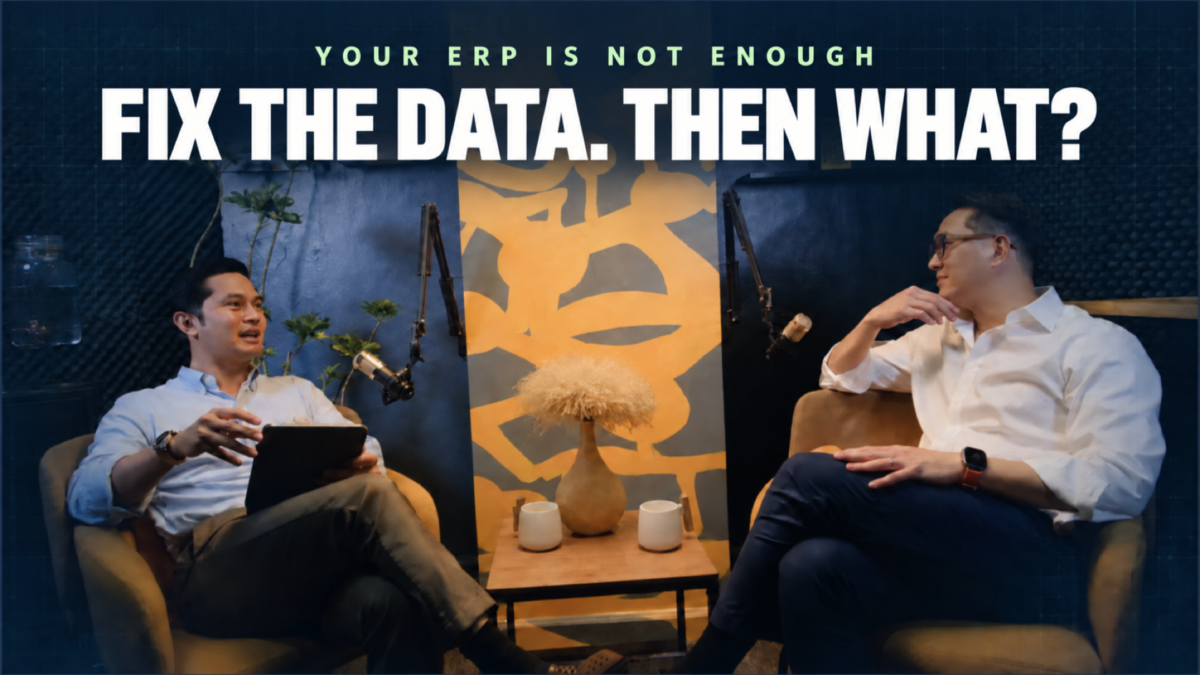
[Embed: Episode 2 of “Your ERP Is Not Enough”]
Why “fixing the data” rarely wins investment on its own
Most leadership teams agree that fragmented data is a problem. Their ERP does not talk cleanly to every operational system. Planning logic sits in spreadsheets. Important documents live in shared drives, filing cabinets, inboxes, or local folders. Experienced employees carry years of exceptions and workarounds in their heads.
When somebody proposes fixing that foundation, the response is usually positive: “Yes, we need to do that.”
Then the investment conversation starts, and momentum disappears.
The reason is simple. “Better data” sounds like maintenance. It does not yet sound like a business outcome.
Leaders do not invest because a database will be tidier. They invest when the foundation enables something valuable: a more accurate demand forecast, a faster response to a supplier delay, less production downtime, fewer hours searching for historical records, or a decision that no longer depends on finding the one person who remembers what happened ten years ago.
The data case and the business case have to be made together.
The longer a company operates, the more context it accumulates
A mature company does not have one clean history. It has layers.
There may be architectural drawings from a previous facility layout. Printed spreadsheets carrying executive signatures. Supplier approvals stored as scanned PDFs. Project sign-offs in email. Production rules embedded in a planner’s workbook. Quality exceptions remembered by an employee approaching retirement.
Every layer made sense when it was created. Over decades, however, those layers become an operating archive that nobody can search as one system.
This is why data fragmentation is not merely an IT inconvenience. It is a continuity risk.
If a senior employee resigns or retires, where does the reasoning behind past decisions go? If a dispute requires evidence from a project completed five years ago, how long does retrieval take? If a new leader wants to understand why a process works the way it does, can the company answer with evidence, or only with anecdotes?
The institutional memory exists. The problem is that the company cannot reliably access it.
Centralizing records is not the same as creating intelligence
One response is to collect everything in a data lake, warehouse, document repository, or upgraded ERP environment. That is useful, but it is not enough.
A system can store every file and still fail to answer a business question.
Data becomes valuable when the organization can establish:
- what each record means;
- where it came from;
- whether it is current and trusted;
- how it relates to customers, suppliers, assets, projects, and processes;
- which business rules apply; and
- who is allowed to use it for which decision.
NIST research on manufacturing data makes this distinction explicit. Manufacturing systems generate rich product and process data, but organizations often lack the standardized infrastructure required to place that data in context and turn it into useful knowledge. NIST’s reference implementation fused design, planning, manufacturing, and inspection data specifically to support lifecycle decisions (NIST, 2018).
Connectivity moves information. Context makes that information usable.
What a system of intelligence actually does
A system of intelligence sits across the tools a company already uses. It does not need to replace the ERP, MES, CRM, document repository, or planning system. It connects them, preserves their roles, and creates a shared operational context above them.
That layer can do four important jobs.
1. Retrieve the company’s memory
Instead of asking employees to search across folders, systems, and paper records, the intelligence layer can retrieve relevant information across structured and unstructured sources.
A project manager could ask: “What caused the last three delays on projects using this vendor?”
The answer might require purchase orders from the ERP, project notes from a shared drive, email approvals, quality records, and a planner’s historical spreadsheet. The value is not simply finding documents. It is connecting them to the question being asked.
2. Understand the current operating context
The same layer can combine live and historical signals: inventory, orders, machine state, staffing, supplier performance, quality events, and financial constraints.
IBM describes enterprise AI as dependent on data ingestion and integration across ERP platforms, operational databases, and other sources. Its guidance also emphasizes that enterprise AI must combine technology, processes, people, governance, and business objectives—not merely deploy a model (IBM, “What Is Enterprise AI?”).
When the company’s context is connected, a leader no longer has to assemble the operating picture manually before every decision.
3. Forecast outcomes and test scenarios
Once trusted data is contextualized, forecasting becomes more than extrapolating last month’s spreadsheet.
Models can estimate demand, identify delivery risk, anticipate maintenance needs, or simulate the effect of a new production sequence. Leaders can compare scenarios before committing resources.
This is where the data investment becomes visible. Clean records are not the outcome. Better decisions are.
4. Power governed AI agents
Agentic systems can retrieve information, reason across defined rules, prepare recommendations, and execute approved steps across business applications.
But an agent is only as reliable as the context it receives. Connecting it to more repositories does not automatically tell it which number is authoritative, which definition applies, or whether a record is current.
That is why governance, lineage, ownership, and business meaning belong inside the architecture from the beginning. AI at machine speed can compress decision time dramatically. It can also amplify a fragmented process just as quickly.
Seconds instead of days—but only for a well-defined decision
The promise of a system of intelligence is not that “AI knows the whole company.” That claim is too broad to be useful.
The practical promise is narrower and stronger: for a defined decision, the system can assemble the relevant evidence, apply the right context, and return a governed answer in seconds or minutes instead of forcing people to spend days searching and reconciling.
Consider a supplier payment that historically required a printed spreadsheet and a CEO signature. A useful intelligence layer would not simply digitize the paper. It would understand the approval rule, verify the purchase order and receipt, surface exceptions, preserve the audit trail, and route the decision to the correct person.
Or consider a ten-year-old project whose original manager has retired. The system could retrieve the drawings, supplier records, changes, quality events, and sign-offs associated with that project, then summarize the history with links back to the source evidence.
The goal is not speed at any cost. It is faster access to trustworthy context.
Do not wait for perfect data
“Fix the data first” can become another excuse to delay if it means cleaning every record in the company before building anything useful.
Start with one high-value decision.
Map the systems, files, documents, and people that contribute to it. Identify which sources are authoritative, where definitions conflict, which steps depend on tacit knowledge, and what level of accuracy or human approval the decision requires.
Then connect only what that use case needs.
This creates a proof of value rather than an endless data program. The company improves a real decision, demonstrates the return, and expands the intelligence layer one process at a time.
A practical sequence for leaders
The path from ERP records to operational intelligence can be framed in five moves:
- Choose the decision. Start with a recurring decision tied to revenue, margin, risk, capacity, or customer service.
- Trace the real information flow. Include the ERP, operational systems, spreadsheets, documents, and human knowledge actually used.
- Establish trusted context. Define ownership, meaning, freshness, relationships, permissions, and source authority.
- Build the intelligence use case. Apply retrieval, forecasting, optimization, or an agent only after the context is usable.
- Close the loop. Measure the result and write approved actions back into the systems where work happens.
This is the shift from a data-cleaning project to an operating capability.
Your ERP should remain the record. It should not be the limit.
The message from Episode 1 still holds: your ERP is essential, but it is not enough.
Episode 2 adds the next step. Fixing fragmented data matters because it creates the foundation for a system that can understand the company in context. That system can recover institutional memory, connect live operating signals, forecast likely outcomes, and support governed action.
The competitive advantage is not owning more data.
It is shortening the distance between what the company knows and what the company can do.
Frequently asked questions
What is a system of intelligence?
A system of intelligence is a connected layer that combines data from systems of record with operational context, business rules, and analytical or AI capabilities. It helps people understand conditions, evaluate possible outcomes, and decide what to do next.
Does a system of intelligence replace the ERP?
No. The ERP remains the trusted record for core transactions. The intelligence layer connects it with other systems, documents, real-time signals, and human knowledge so decisions are not constrained by the ERP’s data model alone.
Do we need to clean all company data before using AI?
No. Begin with a valuable decision and improve the specific sources and context required for that use case. Trying to perfect every record before delivering value often turns data readiness into a long, unfunded program.
What happens to historical documents and unstructured data?
They can be indexed, classified, connected to business entities, and made retrievable with appropriate permissions. The important step is adding context and traceability so an AI system can cite and use the right source instead of treating every document as equally authoritative.
Where should a company start?
Choose a recurring operational decision that currently requires manual searching, reconciliation, or help from a key employee. Map how that decision is actually made, then build a proof of value around reducing its time, cost, or risk.
Build the layer that turns records into decisions
At Embiggen X, we start with the process, not the model. We identify the decision that matters, connect the systems and knowledge it depends on, and build the intelligence layer around the operation you already have.
Book a free AI assessment and find out what your company could do once its data can finally work together.
Sources
- Bernstein, W. Z., Hedberg, T. D., Helu, M. M., and Feeney, A. B. “Contextualizing Manufacturing Data for Lifecycle Decision Making.” International Journal of Product Lifecycle Management (2018). NIST publication
- Helu, M., Morris, K., Jung, K., Lyons, K., and Leong, S. Current State and Future Roadmap of Distributed Manufacturing Systems. National Institute of Standards and Technology (2020). NIST publication PDF
- IBM. “What Is Data Intelligence?” ibm.com/think/topics/data-intelligence
- IBM. “What Is Enterprise AI?” Updated June 5, 2026. ibm.com/think/topics/enterprise-ai