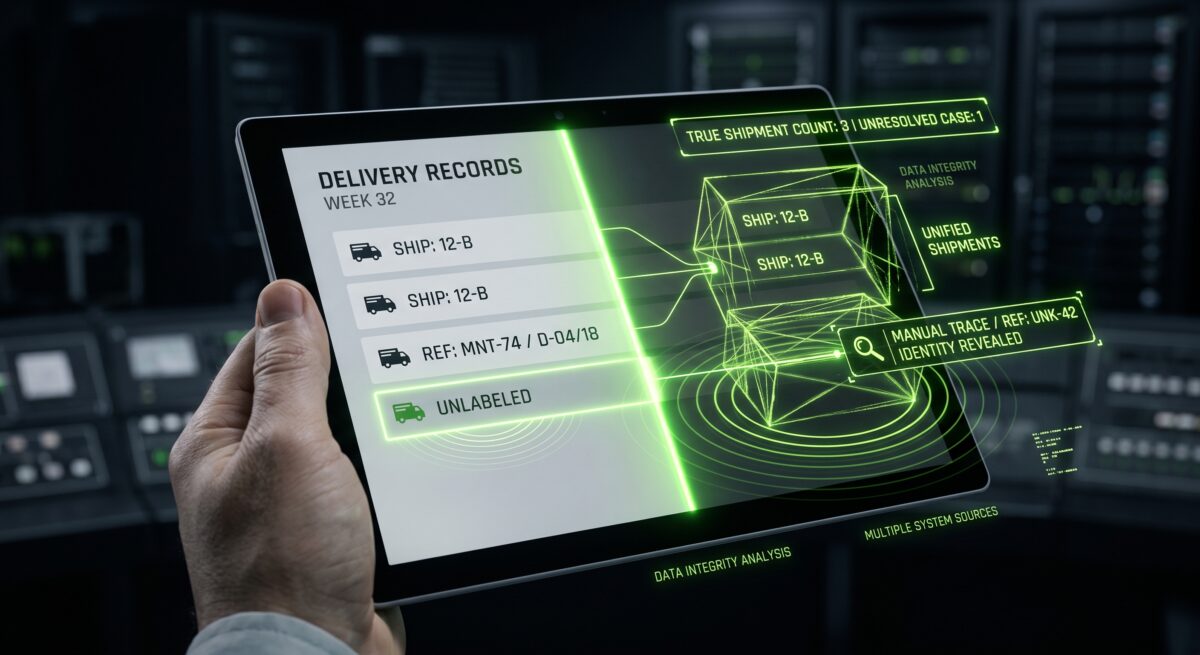
Six delivery records came in over the course of a week. On paper, that’s six separate things to track, six line items, six potential decisions about what to do with each one. Look closer and three of them are the same shipment, logged twice by two different systems that never talked to each other. A fourth arrived with no usable label at all, someone had to physically open it and trace it back by hand before anyone could tell what it was.
So the real count wasn’t six. It was three shipments, one unresolved case that never should have needed a manual investigation, and a data set that had been quietly lying about its own size the whole time.
Most operations look exactly like that once you actually check.
Why the count is always wrong
Data about the same real-world application, a delivery, a supplier, a product, tends to arrive from more than one direction. An email confirms the order. A supplier portal logs the shipment. A scanned delivery note gets filed somewhere else. Each of those paths has its own format, its own person doing the typing, and its own chance of a typo, a missing field, or a shipment getting logged before someone realizes it was already logged an hour earlier by a different system.
Peer-reviewed research on manual data entry accuracy found error rates ranging from roughly 0.5% to 4% per field depending on entry method, even for trained staff working from standardized forms, with single-entry and visual-checking methods, the most common in day-to-day operations, landing at the higher end of that range (Barchard & Pace, 2011, Computers in Human Behavior). That range isn’t the whole story, though: error rates on messy or handwritten source documents climb further under time pressure, and the errors that slip through are rarely the kind a validation rule catches, most fall inside the allowed range for the field, they’re just wrong. None of that requires anyone to be careless. It’s what happens when data enters an organization through several uncoordinated doors at once, and nobody is checking whether two of those doors just let the same thing in twice.
APQC’s benchmarking research puts a number on where that lands even at the high end of performance: organizations in the top quartile for accounts payable still see 0.8% of annual disbursements come back as duplicate or erroneous payments. Not the worst-run companies. The best-run ones. Multiply that percentage across a year of transaction volume in a mid-sized operation and it stops looking like a rounding error.
What running on unreconciled data actually costs
The six-records example is small on purpose, it’s easy to picture. The financial version of the same problem is not small. Gartner puts the average annual cost of poor data quality at $12.9 million per organization. IBM’s broader estimate puts the economy-wide cost of bad data at roughly $3 trillion a year in the US alone. Neither number is about one dramatic failure. Both are about the slow accumulation of small reconciliation gaps, the kind that show up as three duplicate delivery records nobody caught for a week.
On the accounts payable side specifically, where duplicate and unreconciled records show up constantly, Ardent Partners’ invoice-processing benchmarking puts the average cost to process a single invoice at $9.40, against roughly $2.78 for organizations with mature automation in place, a gap driven almost entirely by how much manual reconciliation still happens per invoice. That gap is the direct, measurable cost of skipping the read-clean-reload step this post is about.
Why most master data management projects fail anyway
Here’s the part that doesn’t get said enough: buying a master data management platform doesn’t fix this by default. Research on MDM implementations puts the failure rate as high as 76%, with the majority of programs stalling before they ever reach full production. That’s a strange number for a category with such a clear, well-documented problem to solve.
The reasons cited most often aren’t technical. They’re a missing or weak business case, MDM treated as an IT initiative instead of an operational one, and a rollout scoped around “clean all the data” instead of a specific decision the business actually needs to make better. In other words: companies buy the tool before diagnosing where their reconciliation gap actually lives, then wonder why a platform sitting on top of an undiagnosed problem doesn’t solve it.
That’s the same failure pattern we see across AI initiatives generally, not just MDM. Technology bought ahead of diagnosis tends to sit unused or half-adopted, because it was scoped to a category of problem instead of the operation’s actual one. A master data management platform can deduplicate records. It can’t tell you which reconciliation gap is costing you the most, or which decision in your operation depends on getting that specific record right. That’s a diagnostic question, not a software feature.
What a fix actually looks like
The pattern that works isn’t “review everything more carefully,” which doesn’t scale past a handful of records a day. It’s a pipeline that does three things automatically, before data ever reaches a system that depends on it:
- Read what’s coming in, regardless of format, a structured feed, a scanned document, or a manually entered line, without requiring a person to first decide it’s worth checking.
- Clean it. Match new records against what’s already known, flag duplicates instead of silently loading them as new entries, and surface anything that doesn’t resolve cleanly, like an unlabeled shipment, for a fast manual check instead of an open-ended investigation.
- Reload it, verified. Once a record is checked, deduplicated, and correctly identified, it goes back into the systems that depend on it, ERP, planning, procurement, with a traceable link back to its source.
Done well, this runs continuously rather than as a one-time cleanup project. Gartner’s research on organizations with mature MDM practices in place shows measurable results from that kind of continuous reconciliation: up to a 20% increase in data accuracy, and an average 45% reduction in the manual effort spent on data reconciliation itself. That second number is the one worth sitting with, fewer people spending their week manually tracing unlabeled shipments, not just cleaner data on a dashboard somewhere.
Where this fits into a bigger data foundation
This kind of reconciliation gap is one piece of a pattern we see across mid-market operations generally: the data usually exists, it’s just duplicated, scattered, or disconnected from the systems that need it clean. Procurement is often where it shows up first, since it involves the highest volume of external, multi-source data entering the business. If that’s the part of your operation feeling this the most, it’s worth reading alongside how AI makes procurement more efficient.
Our Method starts by mapping exactly where reconciliation gaps like this one actually exist in an operation, and what decision they’re currently distorting, before recommending any platform. That diagnosis-first sequence is the difference between an MDM project that becomes one more entry in that 76% failure statistic and one that doesn’t. Xentral is built to run the read-clean-reload pipeline continuously, unifying ERP, CRM, spreadsheets, and incoming operational data into one structured, traceable layer, with the option to keep everything on-premises where full data security is a requirement.
FAQ
What is a master data management example in practice? A concrete case is duplicate or mislabeled records entering an operation from multiple sources, an email, a supplier portal, a scanned document, that get automatically matched, deduplicated, and reconciled into one trusted record per real-world entity before they reach a system of record.
Why do master data management projects fail so often? Research on MDM implementations puts failure rates as high as 76%, most commonly due to a weak or missing business case, the initiative being scoped as an IT project rather than an operational one, and platforms being deployed without first diagnosing which specific reconciliation gap is actually costing the business.
How much does poor data reconciliation actually cost? Gartner estimates the average cost of poor data quality at $12.9 million per organization annually. On the accounts payable side specifically, unreconciled and duplicate records help push average invoice processing costs to roughly $9.40, more than triple the cost seen at organizations with mature reconciliation in place.
Does this problem go away once an AI system is involved? No. AI systems act on the data they’re given without applying the sanity check a person normally would. A duplicate or mislabeled record that was never flagged upstream won’t be caught by an AI model either, it will simply be used with full confidence.
What’s the first step toward fixing this? Identify which specific decisions are currently being made on unreconciled or duplicated data, not the whole data set at once, and build the read-clean-reload pipeline around resolving that gap first.
Sources
- Gartner, “Data Quality: Why It Matters and How to Achieve It” (cost of poor data quality, $12.9M/year average). gartner.com/en/data-analytics/topics/data-quality
- IBM, “The True Cost of Poor Data Quality” (economy-wide cost estimate, ~$3 trillion/year in the US). ibm.com/think/insights/cost-of-poor-data-quality
- Profisee, “Making an Effective Business Case for Master Data Management” (MDM program failure-rate research). profisee.com/blog/making-an-effective-business-case-for-master-data-management
- Semarchy, “Master Data Management Statistics: What You Need to Know” (Gartner-attributed accuracy/efficiency/reconciliation-effort figures). semarchy.com/blog/master-data-management-statistics-what-you-need-to-know
- Transformance.ai, “Cost Per Invoice: 2026 Benchmarks for AP and AR Teams” (Ardent Partners invoice-processing cost benchmarks). transformance.ai/blog-posts/cost-per-invoice-benchmarks
- Barchard, K.A. & Pace, L.A. (2011), “Preventing Human Error: The Impact of Data Entry Methods on Data Accuracy and Statistical Results,” Computers in Human Behavior, 27(5), 1834–1839 (peer-reviewed study comparing data entry methods and resulting error rates). doi.org/10.1016/j.chb.2011.04.004
- Reconciler AI, benchmarking data (APQC-sourced duplicate/erroneous disbursement rate). reconciler-ai.com/benchmarks
Want to know how much of your own operational data is duplicated or unresolved right now? Book a free AI assessment.