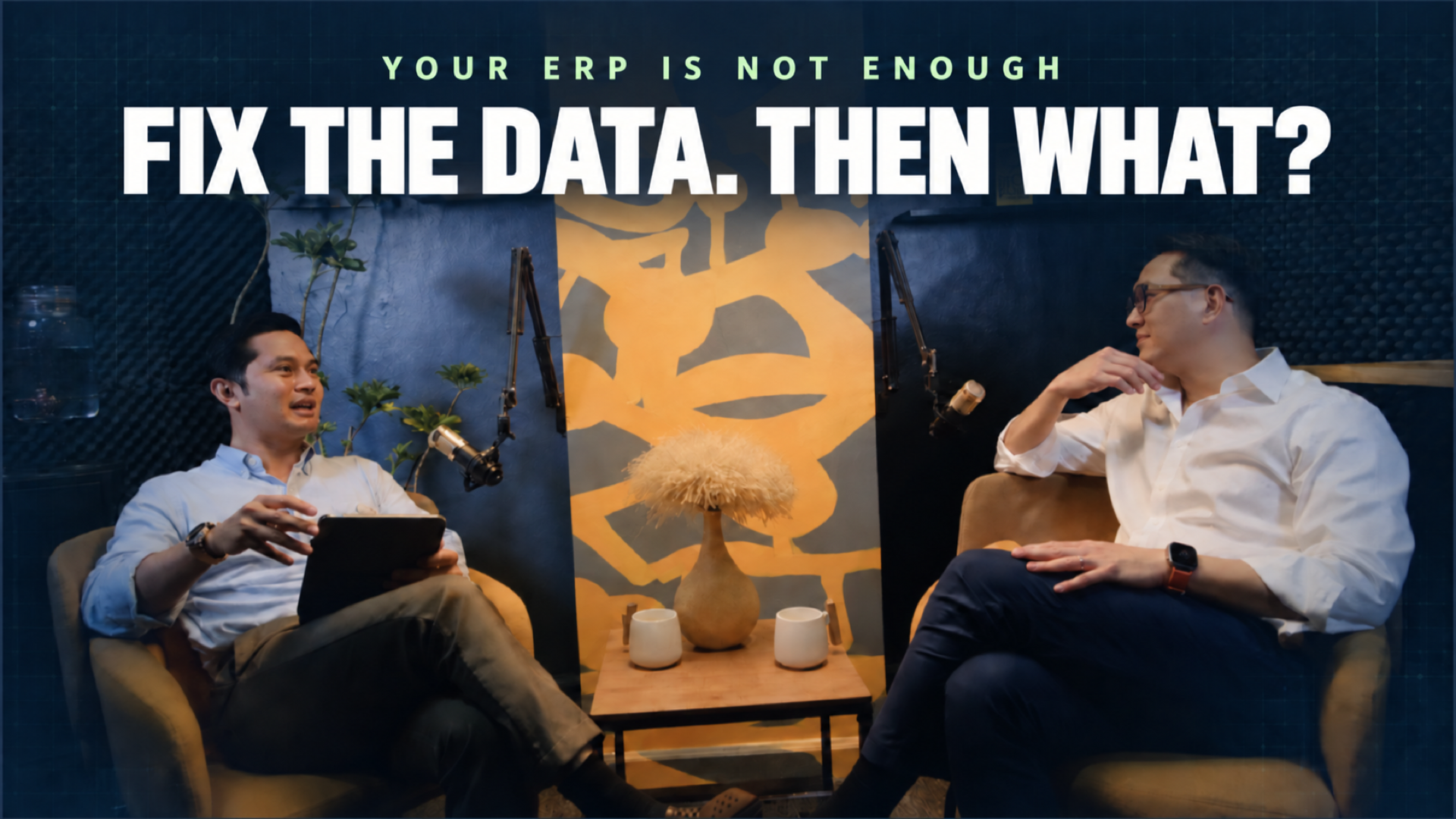
Ask most industrial sector companies what went wrong with their last transformation project and you’ll get an answer about the software. The platform didn’t do what the demo promised. The integration took twice as long as scoped. The vendor didn’t understand how a plant actually runs. All of that might be true. None of it is usually the real problem.
The real problem, in the large majority of cases we’ve seen, is that someone specified a solution before anyone had properly diagnosed the operation it was supposed to fix. And that single sequencing mistake, implementing first and understanding later, is expensive enough on its own to explain most of what industrial leaders write off as “digital transformation just doesn’t work here.”
The 30-45% number that should worry every industrial ops leader
McKinsey’s research on capital-project delivery in the industrial sector puts a hard figure on this: on average, capital projects in the sector overrun their budgets and schedules by 30 to 45 percent, based on a survey of senior project executives across the industry. That’s not a rounding error. For a company running a multi-year, multi-million-dollar transformation, a 30-45% overrun is often the difference between a program that gets renewed and one that gets quietly killed at the next budget review.
Industrial sector enterprises are especially exposed to this because of what they’re actually coordinating: manpower, machinery, and physical resources spread across sites, shifts, and vendors, not just software licenses. When the underlying diagnosis is thin, two things tend to happen. Either the organization can’t fully use the assets it already has: plant floors routinely run at around 60% Overall Equipment Effectiveness against a world-class benchmark of roughly 85%, according to OEE benchmarking data widely used across manufacturing. Or it overspends trying to compensate, layering new technology on top of a problem nobody actually located.
The third outcome is the most expensive of all: redoing the project. Work gets specified against a guess about the operation instead of a diagnosis of it, the guess turns out wrong six months in, and the team is back at the starting line with a new budget request and a harder conversation about credibility.
Why “implementation-first” feels faster (and usually isn’t)
There’s a reason so many transformation programs skip straight to implementation: it feels like progress. A signed statement of work, a kickoff meeting, a Gantt chart with dates on it: all of that produces the appearance of momentum in a way that “we spent six weeks understanding your operations” doesn’t, at least not to a steering committee under pressure to show movement.
But the data on what actually predicts success tells a different story. Research from VML Enterprise Solutions surveying 4,000 business leaders found that 64% of digital transformation projects start without a clear roadmap, and that projects in the study averaged $10.9 million in cost with a 37% failure rate. Separately, Gartner’s 2024 global survey of more than 3,000 CIOs and technology executives found that only 48% of digital initiatives enterprise-wide meet or exceed their business outcome targets. The “Digital Vanguard” organizations that clear 71% success have one thing in common: business and technology leadership co-own delivery from day one, rather than the business side handing a spec to a vendor and waiting for results.
That co-ownership point matters more than it sounds like it should. It means the highest-performing transformations aren’t the ones with the best technology. They’re the ones where the diagnosis was shared, contested, and refined by both sides before a single system got implemented.
What “looking under the hood” actually means in practice
At Embiggen X, this is the starting premise of how we work, not an afterthought bolted onto a sales process. Before we recommend an implementation, we look into the client’s actual operations: how manpower, machinery, and resources are really being used day to day, where the friction is, and, critically, why. Not the symptom the client walked in describing, but the operational root cause underneath it.
That diagnosis phase is deliberately unglamorous. It means pulling together operational data that’s often scattered across disconnected systems, spreadsheets, and tribal knowledge before proposing anything, which is the same reason a connected data foundation like our Xentral product exists as groundwork rather than an add-on. You cannot diagnose an operation you can’t see clearly, and most industrial companies genuinely cannot see their own operations clearly, not because the data doesn’t exist but because it’s never been assembled into something a team can actually query and trust.
Our method treats this diagnosis as a distinct phase with its own deliverable, not a two-day workshop that gets waved through on the way to a demo. What comes out of it is a specific, evidenced account of exactly where the 30-40% of project spend an industrial sector enterprise is at risk of losing is actually going, and what would have to be true operationally for a given implementation to close that gap rather than just move it somewhere else.
Why diagnosis-first is what makes a multi-year commitment possible
Here’s the part that’s easy to miss: diagnosing deeply before implementing does more than prevent an early stumble. It’s specifically what makes a multi-year transformation, as opposed to a single project, something a client can commit to with confidence.
A multi-year roadmap is, by definition, a bet on a sequence of decisions made over time, most of which haven’t been made yet when the program kicks off. If phase one is built on a shallow read of the operation, every subsequent phase inherits that error and compounds it. If phase one is built on a real diagnosis, later phases can be planned against evidence instead of assumption. That’s the difference between a roadmap and a guess with a timeline attached.
BCG’s research on transformation success backs this up in a specific way: only 30% of transformations in their study achieved their objectives, but organizations that scored well on six specific factors flipped their odds of success from 30% to 80%. One of those six factors was rigorous progress monitoring against defined outcomes: 90% of the successful transformations in BCG’s dataset had it, versus only 40% of transformations overall. Diagnosis without ongoing measurement is just a better-informed guess. The two have to work together. That’s exactly why we treat forecasting and planning, through tools like Forecast IQ, as a continuous input to the roadmap rather than a one-time planning exercise.
The KPI checkpoint: building in the right to go back to the drawing board
A transformation program that can’t be revisited isn’t confidence, it’s inertia. Real confidence in a multi-year plan comes from knowing that if the program isn’t hitting its KPIs at any given checkpoint, there’s a legitimate, structured way to go back to the drawing board, not a quiet abandonment eighteen months in when the sunk cost has already become undeniable.
This is where a lot of vendor relationships quietly fail even when the technology itself works. The implementation partner treats the original scope as fixed and any deviation as scope creep to be billed for, rather than as new information that should update the plan. The client, meanwhile, has no real mechanism to say “this isn’t working the way we expected” without it reading as a failure on their part. Neither side is set up to adapt, so both sides keep executing a plan they’ve privately stopped believing in.
It’s a two-way conversation, not a one-way pivot
This is the part of the transformation conversation that gets skipped most often: when a program isn’t hitting its KPIs, it’s not solely the client’s job to change. The implementation partner has to be willing to revisit its own assumptions, its own sequencing, and sometimes its own recommendation, not just help the client adjust internally.
That’s a genuinely uncomfortable standard for a vendor to hold itself to, because it means treating “this isn’t working” as shared information rather than a client-side problem to be managed. But it’s the only version of the relationship that actually supports a multi-year commitment. A partner that only ever tells a client what to change, and never names what it’s going to change about its own approach, has quietly downgraded itself from transformation partner to contract executor.
What this looks like in an actual engagement
In practice, this plays out as a cycle rather than a straight line: diagnose the operation, plan the implementation against that diagnosis, deploy, measure against defined KPIs, and, if the numbers say the plan was wrong about something, revisit the diagnosis rather than pushing forward on the original assumption. That loop is what lets an industrial sector enterprise commit to a multi-year program instead of re-litigating trust in the vendor relationship every six months.
It’s also why we don’t front-load implementation recommendations before the diagnosis phase is done, even when a client is under pressure to show fast movement. The 30-45% budget and schedule overrun that the industrial sector has come to treat as close to normal is, at root, a sequencing problem more than a technology one. Sequencing problems get fixed by changing the order operations get done in, not by buying a different platform to do them in the same order.
FAQ
What does “diagnose before implement” actually mean for a transformation project? It means the implementation partner audits how manpower, machinery, and operational data are actually being used, and why current performance looks the way it does, before recommending any specific software, process change, or technology deployment, rather than proposing a solution based on an initial scoping call.
Why do industrial sector companies specifically lose 30-40% of project spend? Because they’re coordinating large amounts of manpower, machinery, and physical resources across sites; when the underlying operational problem isn’t correctly diagnosed, that spend goes toward underused assets, overspend to compensate for gaps, or redoing work that was specified against the wrong assumption.
How is a multi-year transformation roadmap different from a series of separate projects? A multi-year roadmap treats later-phase decisions as dependent on evidence gathered during earlier phases and ongoing KPI measurement, rather than locking in the full sequence of implementations up front based on a single early assessment.
What should change if a transformation program isn’t hitting its KPIs? Both sides should revisit the plan. The client may need to adjust internally, but the implementation partner also needs to be willing to reconsider its own assumptions and recommendations, treating a missed KPI as new information rather than as evidence the client simply needs to try harder.
Does a longer diagnosis phase slow down time-to-value? It slows down time-to-first-implementation, but the evidence suggests it improves time-to-real-value: research shows the majority of digital transformations that skip a clear roadmap either fail outright or significantly overrun budget and schedule, which costs far more time overall than a properly scoped diagnosis phase.
Sources
- McKinsey & Company, “Why the Time Is Right to Reinvent Capital-Project Delivery”: https://www.mckinsey.com/capabilities/operations/our-insights/why-the-time-is-right-to-reinvent-capital-project-delivery
- L2L, “What Is OEE? Overall Equipment Effectiveness Explained”: https://www.l2l.com/blog/what-is-oee-overall-eqipment-effectiveness-explained
- VML Enterprise Solutions, “Unlocking the Power of Digital Transformation,” cited via Process Excellence Network: https://www.processexcellencenetwork.com/digital-transformation/news/digital-transformation-cost-10-million-37-percent-fail
- Gartner, “Gartner Survey Reveals That Only 48% of Digital Initiatives Meet or Exceed Their Business Outcome Targets” (October 2024): https://www.gartner.com/en/newsroom/press-releases/2024-10-22-gartner-survey-reveals-that-only-48-percent-of-digital-initiatives-meet-or-exceed-their-business-outcome-targets
- Boston Consulting Group, “Flipping the Odds of Digital Transformation Success”: https://www.bcg.com/publications/2020/increasing-odds-of-success-in-digital-transformation
See where your operation is actually losing budget before you commit to a new platform. Book a free AI assessment with Embiggen X.